

Sunshine in a Bag, Plastic in the Sand
i didn't choose my favorite band, they've found me. over and over again.

I came across a Reddit thread Monday morning asking users which critically acclaimed band simply never landed for them. The original poster attached a picture of Coheed & Cambria, which I understood — to an extent.

Back in middle school, it seemed only the asymmetric-banged suburban male oft imagined themselves protagonists in interstellar blood feuds. I knew few others who spent their nights belting “A Favor House Atlantic” at the ceiling, believing in a future where bands would tell serialized stories in song.
Alas, my interest in Coheed’s Keywork universe waned after their fourth album — when for me, the mythology became too dense to experience the lyrics.
If you happened to have copped my fantasy novel, The Spiral Stair, you might appreciate the irony of that statement.
Normally, I avoid these sorts of threads because taste discourse, especially on Reddit, is less conversation than ritualized shaming between people trying to demonstrate the correct balance of cultural literacy without accidentally revealing sincere attachment to anything.
But the fifth-most upvoted: Gorillaz — that triggered a pull in me.
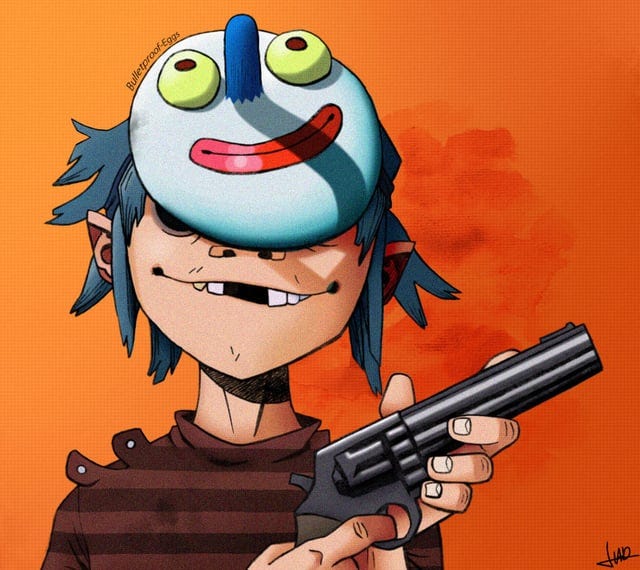
Gorillaz? The world’s best virtual band? Not landable?
F*ck outta here.
**Author’s note: “Clint Eastwood” (2001) is my ace in the hole when it comes to karaoke, allowing its singer the opportunity to both croon and drop fire bars. “Feel Good Inc.” (2005) is a close #2. This bias will be evident throughout the rest of the article.**
Other top mentions in “Bands/Artists You Could Never Get Into?” thread: Tame Impala, AC/DC, Blink-182. Grateful Dead, even.
These names seem more viable for this sort of list. Despite expanding their respective genre’s appeal, those artists’ are largely bound by their audiences’ expectations. Meaning, if you don’t vibe with their first album or top single, you probably won’t like the rest of the catalog.
I’m sorry, I love Kevin Parker just as much as the next bandana-wearing zennial, but I don’t think Tame’s latest album sounds any different from The Slow Rush (2020). He’s just using words from a different perspective. I like it, but it’s not going to convince many people who didn’t like Currents to suddenly jump onboard.
For AC/DC, you either like the riffs or you don’t.
Blink-182: more of the same.
TBH, I don’t know enough about the Grateful Dead to comment on them; all I know is I like meeting Deadheads. They’re fun.
My experience with Coheed and Cambria doesn’t fit this bill because their space-operatic ethos repelled typecasting.
If Claudio Sanchez’s voice wasn’t so darned unique, you could listen to songs 2–4 on Good Apollo, I’m Burning Star IV (2005) and believe you were listening to three different bands.
Gorillaz demonstrates a similar advance through time and space, but to the nth degree.
My infatuation with Gorillaz started in my living room twenty-four years ago.
I was doing then what ten-year-old me did every Saturday morning: flipping between VH1 and MTV, whichever wasn’t on commercial.
One fateful morn, I found myself watching, for the first time, a cartoon band singing a song I liked from the jump.
Stranger still, I couldn’t peg the sound to a genre. I’d never seen Looney Tunes characters rap. I’d also never seen an album cover I wished was a TV show.
I didn’t have the vocabulary for it at ten years old, but what Gorillaz offered me in that moment was not a band so much as a place.
Their front man, Damon Albarn, spent the ’90s as that lad in the studio, stretching similar strands of societal grievance into twelve tracks and a deluxe edition.
As his time with Brit pop behemoth Blur wound down, Albarn realized he’d have to create a place for that grievance. The next phase. So he teamed up with graphic artist Jamie Hewlett, and quite literally sketched out a band for the 21st century.
Most artists, even great ones, eventually trap themselves inside the first thing people loved about them. The sound hardens to the point that the only question remaining is the temperature of their next offering. Or the artist rebels against their meal ticket entirely, usually with disastrous results.
I’m looking at you, spoken-word interludes and modular synthesizers.
Gorillaz avoided that trap because the project was never built around a single person saying a single thing. It was built as a collaborative atmosphere through which different things could pass.
That sounds obvious now because CGI cinematic universes and surgically enhanced personality game shows are common like a lunchtime sandwich. But in 2001, seeing a cartoon band on MTV didn’t feel like a corporate money grab.
I’d tapped into a transmission from another side of the culture — something adjacent to everything else on TV but not reducible to any of it.
“Clint Eastwood” didn’t sound like rock, rap, pop, or cartoon music. It sounded like someone had left a haunted Western running inside a British kid’s bedroom while a rapping ghost floated out of the drummer.
Typing that now, it reads like a DMT trip. But at the time, it made perfect sense. The song was catchy enough to be normal and strange enough to remain on the fringe.
My bestie Brandon and I would wail the “Clint Eastwood” chorus at sleepovers: “I’ve got sunshine in a bag. I’m useless, but not for long. My future is coming on… is coming on…”
At the time, we were certain this meant we were different. That, in accepting music in this new cartoon form, we would be ready for the future. We weren’t useless, exactly. We were merely pre-useful. Awaiting activation. Two suburban boys with PlayStations, Capri Suns, and the belief that nirvana would arrive once the right song finished buffering.

Now, with enough life behind me to know 2-D was probably singing about the expectant feeling of recreational drugs, I still don’t think the childhood read was entirely wrong.
At ten, I heard destiny. As an adult, I hear self-medication. Somehow, the song survives both interpretations without embarrassment.
An artist “saying something” can be powerful, sure, but it often ages once the message is understood.
For most musicians, the first album carries the thesis, the second refines it, and the third is either accused of losing the plot or repeating it. Before long, fans are less in love with the music than with a fossilized version of how the music once made them feel.
Gorillaz doesn’t work that way for me because the project never asked me to preserve one feeling. It kept returning under new conditions. The same signal came back altered by whatever age I happened to be when I heard it again.
Demon Days sounded like the band had found its grander form: darker, cleaner (sound). Yet sprawling.
“Feel Good Inc.” became this cultural entry point (for obvious reasons). It had the opening laugh, a romping bassline, and this chilling, Pied Piper-esque hook about a windmill for the land. Even a person determined not to like Gorillaz had to admit it slapped.
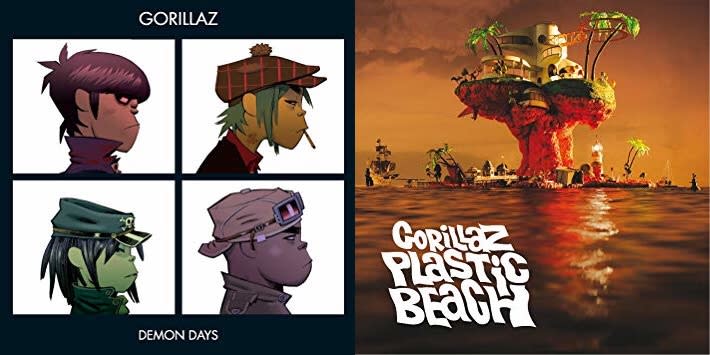
The high school years which filled the five-year lead-up to Plastic Beach did not prepare me for its hardened edges, much less its strange new distance from the Gorillaz I thought I understood.
I was seventeen when it came out, which is the worst possible age to be handed a masterpiece you are not ready to understand. At that point, you want revelations to arrive with the ease of a two-clasp bra in the backseat.
You want a song to announce itself as important in a way that flatters your taste immediately. You don’t want to sit atop an artificial island of trash while melancholy orchestral pop metastasizes ecological dread into glittering decay.
I do, however, remember liking Snoop Dogg as the doomed resort town’s mayor.
Funnily enough, I’ve lived in the LBC since 2021 and think about that prophecy every time I visit the beach and inevitably pick sharp bits of plastic out of my dog’s paws.
Suffice it to say, at first, I only liked “Stylo” — the lead single.
“Stylo” made sense to me. “Stylo” had this night-driving appeal. A song you could grab by the rising synths and say, yes, this part I understand!
The rest of Plastic Beach felt slippery. Not bad. Just harder to place. It didn’t sound like Demon Days. It didn’t give me the earlier Gorillaz pleasures in the earlier Gorillaz way — which felt like betrayal when you’re graduating high school and the culture’s moving faster than you can run.

That’s the part I found missing from the thread about bands people “can’t get into.”
Sometimes, it’s not about landing so much as it’s about hearing it in a place where it echoes.
Plastic Beach took years to become obvious to me. Not intellectually. I could have understood the concept well enough. Synthetic island. Environmental collapse. Fame as waste. Pop music, its beautiful debris. Fine.
But loving a Gorillaz album is different from recognizing the concept. To love Plastic Beach, you need life to make certain sounds available. You need boredom, loss, repetition.
You need shitty jobs, hangovers, errands, equally shitty apartments, not to mention revisiting failed versions of yourself each day in the mirror.
Which is why, at twenty-five, Humanz (2017) hit me so hard.
I know Humanz is not everyone’s favorite Gorillaz album. I understand the complaints. Too many features. Not enough Damon. Too much “party at the end of the world” and not enough sad cartoon man singing directly at your childhood.
Humanz sounds like adulthood — not as a stable identity — but as a crowded room you keep entering under different aliases. It sounds like working nights on bad sleep, losing friends to private algorithms, substances losing their innocence.
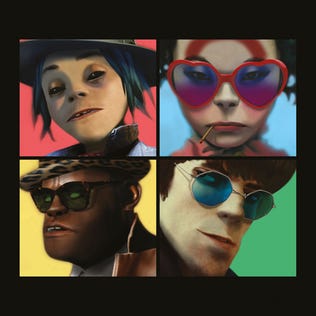
By twenty-five, I had experienced enough successes and failures that the crowdedness of Humanz felt coherent.
No other band had tried harder to reach me because no other band has been so willing to abandon consistency in pursuit of deeper continuity. Most artists confuse coherence with maintaining a sound. Gorillaz understands coherence as maintaining a world through changing conditions.
Which leads us, today, to The Mountain (2026).
Had this album come to me seven years ago, I can’t tell you if I would have been ready to listen. Even now, parts of it sit beyond me — not because they are inaccessible, but because I have not yet lived enough to meet them cleanly.
Damon is fifty-eight. I’m thirty-three.
The cartoon band that gave me “sunshine in a bag” a quarter-century ago has arrived in India, bearing witness not only to death and grief, but also to reincarnation, and the strange possibility that the end of life is another version of returning.
That sounds ridiculous if handled by almost anyone else. An English pop band wandering through sitar instrumentation and afterlife imagery should, by all rights, be unbearable: part gap-year mysticism, part late-career prestige grab, part Sgt. Pepper redux.
But with Gorillaz, it works and I’m willing to listen because they’ve been ‘out there’ far longer than I’ve understood why. What once sounded wrong later became inevitable.
For me, Gorillaz have never been about landing on first listen. Their purpose is to evoke a world coherent enough to survive reinvention, and deep enough that the same echo finds you in a different room, years later.