

Rancholand, pt. 3
Take a trip on the Los Angeles River in late spring with Fletcher and his ragtag crew.

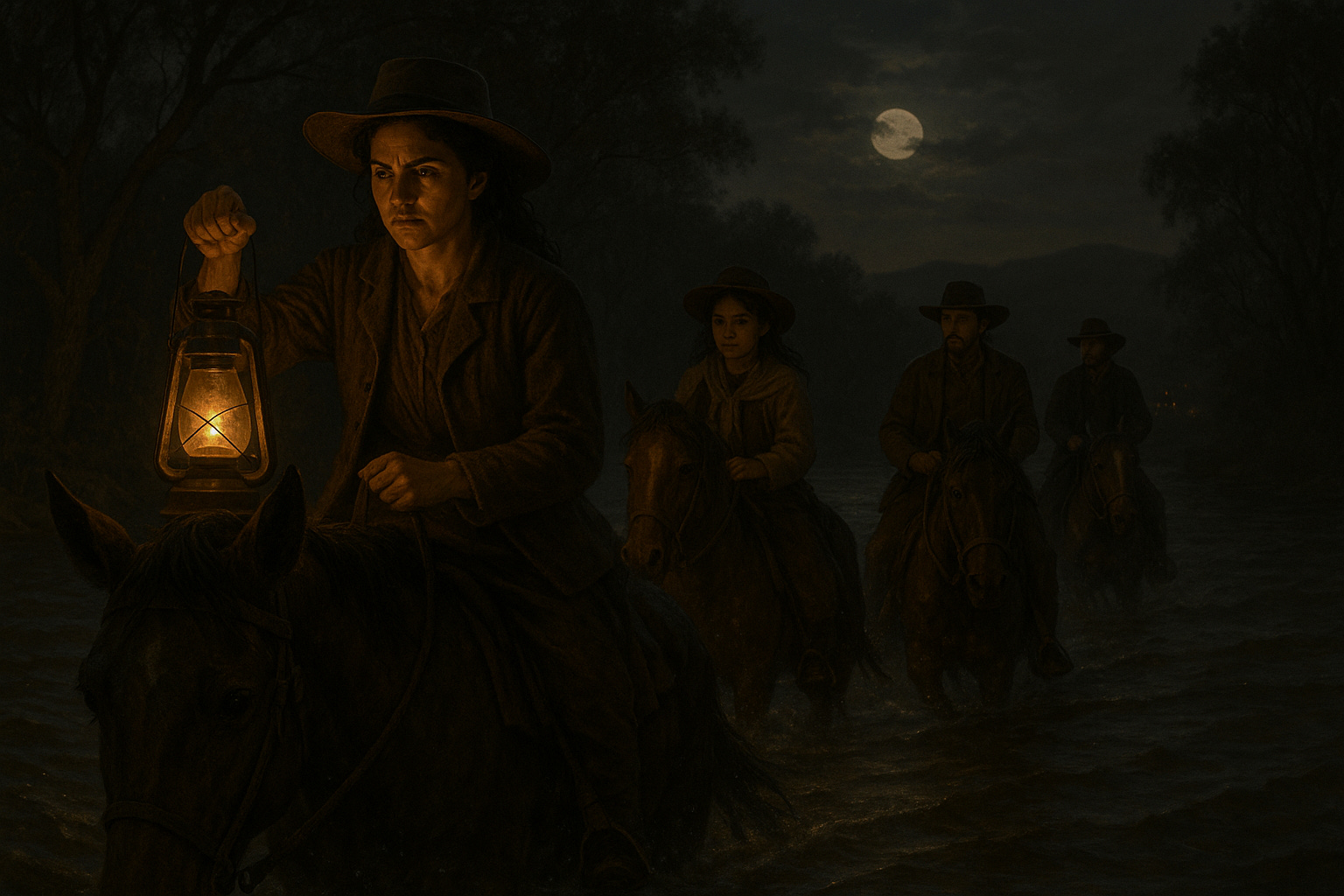
María barked something to the others to follow her, while Medge and I brought up the rear. Crossing the river in early May was difficult enough during the day, much less at night. By now, the rustlers running guns and liquor to Nuevo México had laid out the first boards for the annual bridges. Put ‘em down too early, and a day of rain will see ‘em washed down to San Pedro.
They help mightily with the mucky parts on the floodplain. But your horse needs gumption to cross the riverbed. Water would come up to the horse’s belly, if we’re lucky. For about twenty feet. If we’re lucky.
Muck was the least of our worries.
“We’re sitting ducks if we don’t get across quick!” Medge lamented.
I didn’t have the time to answer, scanning a hundred yards behind for a sign of someone tailing us. All I saw were shadows moving across the buildings, creeping round that burning depot.
“You watch the ground ahead!”
We needed to move quickly as long as María had that lantern. We could risk moving slowly if they couldn’t see us. Then we couldn’t see much, either.
I pulled the reins of my mare, who I quickly discovered, had a problem falling in a line. That wouldn’t make the fording easy. She’d just have to trust us. Easier said than done.
María’s mount neighed as we worked down a mound toward the bottomland trees. The ground was much thicker, but she pressed the colt forward. The other horses shimmied and found their footing, the pace slowing. Boards were fewer and further between.
No day crossing this river was like the next. Enough foot and wagon traffic in one spot builds up mud banks, which serve as fresh pools for boggy water looking for a way out.
I tried not to think about the caked mud marking us when we got out the other side. You had better luck navigating through the slop in the daily sun. Few other than fugitives had a reason to stir up sludge in the middle of the night, especially if the horses got spooked and we had to ditch ‘em.
“This really the way to L’abra?”
“Be quiet, Medge. I’ll tell you if something’s off.”
The lantern had attracted attention. All María’s cunning would be for not if any Rurales saw us cutting south. They could signal to fresher horses at Mission Crossing and ride ‘em hard to cut us off at the Two Rivers.
“¡Más rápido! ¡Más!”
Lanterns had followed us down toward the river. As soon as we had reached the west bank, María snuffed the flame and ripped south. Moonlight coming off the river, split between the scraggly trees, was good enough for her and the horses. All the better if we got out of sight and across before our pursuers could find us.
L’abra was a decent choice. Tucked away against steep hills and far enough from San Rafael. Only problem was, the route would take us through Pico land. I hadn’t had the best experience with Pico men.
“What’s that behind us?” Medge gasped.
“Now they know we’re going south!” Medge hissed, distraught we’d been followed.
What did he expect them to do? Stand around and scratch their heads?
Some folks on the Calle had spoken about old man Pico building a permanent bridge south of where the Hondo met the Angeles River. He wanted the trade coming up from San Pedro, and I didn’t blame him.
But old Pio Pico didn’t control L’abra. Rafael’s Rurales could reach us there by tomorrow morning if we weren’t settled in.
“¡Adelante!” María hollered.
“What did she say?” Medge’s cluelessness baffled me.
But I have a soft spot for lost causes.
“Get ready; she found our spot.”
The girl’s horse had no problem following María into the stream. The water ran slowly, so the splashes were loud.
“Hurry, now! ¡Ellos vienen!” I urged Alberto.
Medge’s horse bunched up to his at the bank, which spooked Alberto’s horse good.
“Go Medge! No time to wait!”
Medge pulled his horse around, and I followed him in. María picked a suitable spot. Water didn’t get past two feet until we were halfway across.
“Try it again now!” I hollered at Alberto, but his horse wouldn’t go.
“María! ¿Qué hacemos?”
She didn’t miss a beat.
“Alberto, ve a San Pedro. Espera mi carta.”
I didn’t know how she planned to get him a letter, but her calmness at the separation surprised me.
“Sí, señora. Hasta pronto. ¡Vaya con dios!”
He didn’t have to yell that last part, especially with people chasing us three hundred yards off. Then, as if his horse had regained all trust, he vanished into the night.
The thick line of trees on the higher east bank provided suitable cover for our climb out of the bottomlands. Good, honest people worked the farms beneath these hills. And that’s what worried me.
They weren’t fighters, and they’d give us up to the Rurales in a heartbeat.
“Come, blanquito. We necesita move.”
“Pero Alberto,” the girl whimpered.
“Él estará bien, Rosa. Estará bien.”
María soon made it clear she had a better horse than all of us. Bypassing the easier line towards houses to our right, she surged the colt up towards a crest that certainly didn’t move us closer to L’abra.
What have you planned for us, María?
Atop the bluff called Paredon Blanco, the flickering lights of the growing city gave us an idea of what we were up against. Lanterns still on the river worked south, while I could tell a mile to our north, another group giving chase—ten or so riders—had just crossed at Mission.
“Móntenlos hard, blanquitos.”
This was gonna be a long night.
“You sure about this, Fletcher?”
“Startin’ to be.” Spurring my horse. “More by the minute.”
I’d crisscrossed this whole damn basin spreading secrets and running steer for los Lugos, los Domínguez, and los Híjares. I’d seen how these caudillos built up private armies and enclaves after the War of 1867.
She wasn’t taking us to L’abra.
I settled in on her left side, pressing forward and hoping the others kept up. I wanted to ask her where she was taking us, but I knew she wouldn’t say.
We hadn’t even reached the thick of a settlement before I noticed shadows moving against interior candlelight. Lot more witnesses than I’m used to. I hadn’t been this way in a year, and for good reason.
“Can we beat them across El Puente?”
A rocky slope slowed us down after we passed farmhouses. She wouldn’t look at me, only forward.
“No sé, blanquito.”
Even if Alberto drew those initial pursuers south, the party coming around Mission had better roads and horses.
“¿Tienes un plan?”
She was thinking. I was thinking. Medge was complaining, mostly in hushed whispers so María couldn’t hear. She could hear him, though. Hell, half of Rancho San Antonio could hear him.
Less than a mile from the Hondo, rounding a bluff, I pulled up. I’d have stopped even if she’d kept going. I had to look down on San Gabriel for any signs of movement. We’d need to lose any tail we picked up in the river towns. I don’t think María thought that far.
At least now I know how much I could trust her decisions.
“Debemos irnos,” María huffed. At first I thought the horse made the sound.
“Ya.”
Maybe if I’d seen movement down there, I’d recommend some crazy maneuver, like sacrificing Medge to lead the horses away while we double-backed on foot.
Now I was making poor decisions. María was right. We had a lead, and we’d have to keep it. Had to pray the time I wasted confirming that fact wouldn’t cost us later.
“What’s wrong, Fletcher?”
“Nothing. She knows what she’s doing.”
Even if she didn’t, it was the right thing to say.
I knew very little about María. I know she didn’t charge us different nor did she with black folks either. And that was all right in my book. I got plenty of jobs drinking in her saloon.
No longer.