

My audience is within sight, just not sure whose
A story about selling myself

It’s not easy selling thoughts at a book fair where a penny fetches too high a price.
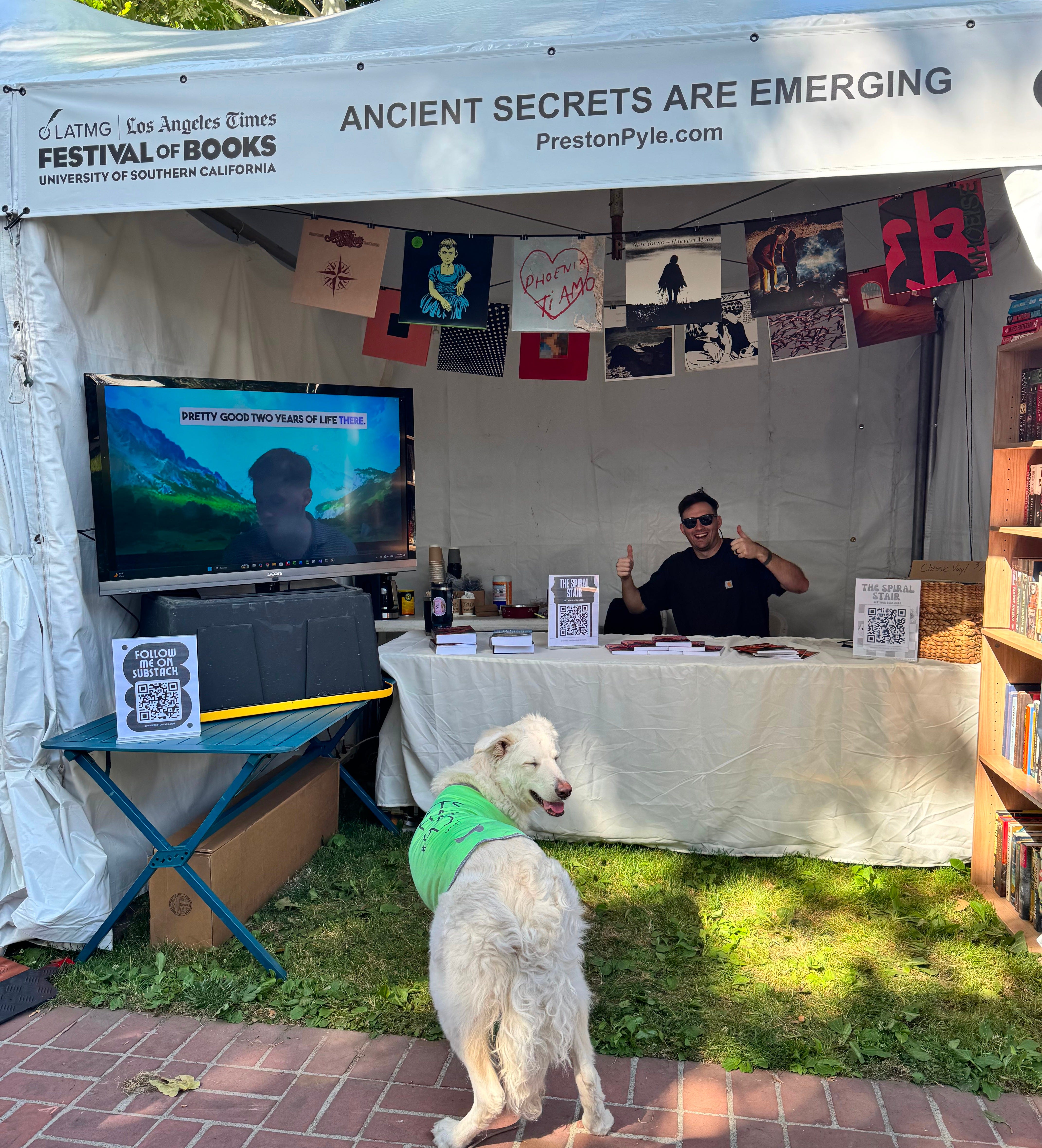
Last weekend, I held court at the LA Times Festival of Books, releasing my fantasy novel, The Spiral Stair. I went in thinking I was going to properly launch a book. I came out realizing that you can only launch a proper book.
I’m not sitting here saying The Spiral Stair is a dull read. But I do acknowledge what I know as fact: in its present edition, standing alone, the appeal is limited. My other titles are no different.
I’m figuring it out. I’m learning how to best reconcile my ideas with a world that wants something different.
I’ve always felt that imbalance between what I want to perceive and how others do, and I hope you bear this self-critique in mind as you read the rest of my lessons learned. I’m not being down on myself—I’m just incredibly realistic and resolved.
But first, I must give you a lay of the land. This festival is well attended by women—and it’s geared toward a particular subset of women who like their male faerie/daemon princes steamy. Tangentially related, the first main stage speaker 100 feet from from my booth was Real Housewives star Lisa Rinna.
So, not exactly my target audience. Not saying Lisa ain’t fabulous, but she didn’t take time during her diva pep talk to shout-out her dungeon master.
As if the audience fit wasn’t jarring enough, it took a few hours before realizing it was more difficult to attract customers with both Shannon and me in the booth.
It was almost as if, as a couple, we were less appealing to speak to—but once Shannon left for the restroom, a coed might happen to peruse my offerings, waiting for a “how are you?” before removing their earphones and saying, “I’m good, thanks.” My experience as a college boiler room manager took it from there.
Conversely, when my nature called, I would come back to Shannon regaling prospects with my thought processes in writing this timeless piece of military fantasy. We had a good number of sales, made some new friends, and marginally boosted my public profile.
I was, however, stupified by the number of baby boomers who wandered into the booth with no intention of learning about—let alone purchasing—my book. Instead, they passed out handouts for their own causes or side hustles like “Complete Worldwide Ministry” or “Let in the Light.”
In other words, they were complete wackjobs. And almost every one told me the same thing—they always wanted to finish their book, had tried for years, and are almost done.
The thought makes me laugh when I look at my KENP read statistics now—a flatline. I know it may take years before someone—anyone—finishes what I wrote. That’s not what anyone hopes for when they start. It’s just the truth.
It’s hard to write a book. It’s even harder to write one worth reading. Most people, myself included, spend so much time fretting over getting it done that we don’t stop to examine if our child is one only a mother could love.
Micro-realizations like that made the weekend valuable. I didn’t learn how to sell a book so much as I learned the ways not to:
1.
The first lesson was that book fairs like this often have author collectives with outreach staff offering free signed copies for a photo with the author.
A sneaky way to get stock footage normalizing far-xx views as well as a letinthelight.faith newsletter one email deeper.
But that’s what I was competing with—free—on both sides of me. As a result, I chose to push attention to the ebook at $5.99.
2.
My next mistake was trying to enrapture people with a witty banner.
“Ancient secrets are emerging” was meant as a cheeky nod to the archaeological dig at the center of my novel. It turned out to be less of a hook and more of a magnet for Epstein truthers, and a repellent for left-leaning women of a certain age still bitter from their ex-husband’s fall into Infowars.
3.
The third mistake was overproducing the experience. I spent two full days building a 30-minute visual loop: me at a microphone, subtitled, delivering commentary drawn from ideas sprinkling my hypothetical wiki page (which doesn’t exist yet, but I plan to have a say in its sections). I thought it would stop people in their tracks.
It didn’t.
People don’t go to festivals, fairs, or farmers’ markets because of your booth. And just because you have a television doesn’t mean it’s more interesting than where they’re already headed. It’s not a reason to stop in a crowded walkway and watch a stranger talk—even with subtitles.
No one stopped.
My elaborate video’s only audience was the poor vendors across from me, who were probably driven insane watching the same 18 clips loop for eight hours.
It forced us to adapt on the second day into a two-slide PowerPoint—one a short synopsis, the other a map of Shaheena, the novel’s setting.
4.
No one cares about free coffee on a hot day. I figured coffee would be a neat “perk” to go with a signed copy of the books I was selling. We bought enough for a hundred servings.
We got one taker, outside of ourselves.
5.
Another tidbit: vendor insurance is absolutely worth it.
Within the first twenty minutes, a vinyl record I had hung with binder clips came crashing down—point first—onto a woman’s cowlick. She said she was fine. She even bought a different vinyl. But still, that could have gone very differently.
6.
I went through different phases over the weekend. The most surprising one was relief.
There were hours where I didn’t even feel like selling. The exertion required to publish left me depleted enough.
It comes from this idea I’ve had for my entire life—that writing is my ticket, my differentiator, the thing that would give me financial freedom, let me be the boss, the entrepreneur, the value creator.
I try not to think that way anymore because the pressure isn’t good for my creative process. I’ve found it’s important to be comfortable writing as someone who doesn’t need to “make it”—who probably won’t—but who still wants to get better and keep going.
Plus, many famous people died unknown. It’s more common than we like to think. Thinking otherwise can be dangerous in a setting like the LA Times festival.
Because standing at a booth, watching people pass by, you realize quickly that maybe one in ten has any real interest in what you’re offering. Which means you’ve got to go after each one of them. Make them reject you. Make them tell me no. Otherwise, I wouldn’t have been trying. Giving the bare minimum effort.
My next novel is Jailbreak! And I while I don’t need an audience, I want one.
Lacking the need is an important truth for your insides, but right there, selling on that USC quad—not needing it would have risked disengaging me from the process and miss people who would’ve cared.
And that balance I wanted arrived, eventually. I remember utter satisfaction on the second day, after enough failed attempts, we (Shannon, really) found a hook that worked:
“Wanna go on an adventure?”
That was it.
And people stopped, and we sold some books.
Note: after getting them sold, there’s still the small matter of getting them read.