

Are Your Ethics Post-Societal?
In 2026, I challenge you to master your own memory, desire, and power to reshape how you view (and are viewed by) society

When I began synthesizing my own philosophical compass in the summer of 2025, I surmised after much amateur research that most great thinkers from Aristotle to Freud conceptualize society as a gestalt of things: institutions, laws, classes, markets, individuals.
Along with language and culture, these concepts have been treated by famous philosophers as layers sitting atop the fundamental aspects of existence, rather than composing its essence.
In my view, having felt detached from society since my first reading of Camus in the eleventh grade, I’ve held this sneaking suspicion that humans don’t describe reality with language, so much as they use it as a store of meaning.
The forces we imagine as backstopping our society—power, memory, and desire—are not described through language so much as they are shaped by it.

In other words, language—and the societies it produces—are more structure than metaphor.
I suppose by the nineteenth century, when science and corporations had laid bare the path of modern life, most thinkers started answering the same basic question:
Why does society feel real, and why does it hold us even when we don’t agree with it?
Karl Marx started with force. Who owns what, who works for whom, who eats and who doesn’t. From there, he modeled meaning flowing upward. Ideas, values, even morality are shaped by material conditions. Language, in this view, is mostly a surface effect—ideology, justification, sometimes illusion. Marx gives us propulsion (mostly toward revolution) but the motion is one-way. Power shapes meaning that doesn’t talk back.

Émile Durkheim noticed something Marx doesn’t linger on: symbols. Durkheim believed symbols don’t just describe society, they bind it. Rituals, shared beliefs, norms—these things feel external and real, even coercive. They organize behavior. They stabilize life. But Durkheim treated symbols like finished structures. Once formed, they sit there, holding society together. He explains stability, not change. His society works—but it doesn’t drift.
Max Weber got closer to the recursive motion of reward and punishment. He watches meaning drain out of the world as systems rationalize. Charisma turns into offices. Ritual turns into procedure. Purpose turns into process. But Weber regarded societal outcomes as loss—meaning disappearing under bureaucracy. What he misses is that meaning doesn’t vanish. It just survives in thinner, more procedural forms.
By the 20th century, the philosophical tone shifted from explanation to suspicion.
Michel Foucault showed that power doesn’t just repress—it produces. It creates categories, norms, identities. Institutions don’t merely control bodies; they make people legible to systems. Language becomes a technology. This is a huge step. But Foucault stops at exposure. He opens the machine, names every gear, but stops short of determining how meaning stabilizes, returns, or exhausts itself.
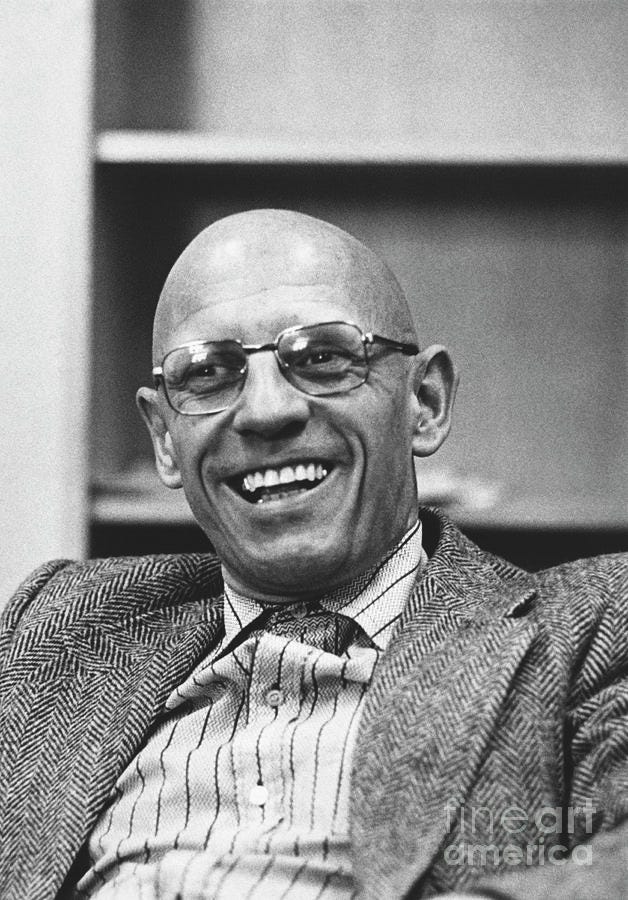
Then Jacques Derrida pulled the floor out entirely. He said meaning is never present—that every word points to another word. There is no final reference point. While devastating, this notion tracks in a prompted, looping world of computation.
But once meaning is endlessly deferred, you’re left with a question Derrida failed to answer:
If nothing ever fully means anything, why does society still function at all?
What all of these thinkers describe—force, ritual, procedure, discourse, deferral—are not competing explanations. They are slices of the same moving system. What’s missing is the idea that meaning doesn’t just flow or dissolve.
It returns.
Language shapes power, memory, and desire. Those forces harden into structures like society and culture. Those structures teach us how to speak, want, remember.
Around and around it goes. Not as repetition, but as a feedback loop.
In this model of symbolic return, we recast consciousness as a legible path through this loop—a sort of brief, instantaneous transcendence.
Yet if meaning does not originate in truth or belief, but in recursive return—if society continues not because we agree with it, but because we keep speaking it—then ethics can no longer be about obedience or transcendence.
They become a question of maintenance.
So how does one maintain ethics in a world like this, if not by clinging to fixed rules, and not by abandoning structure altogether?
In my view, ethics become a practice of balance: understanding history without becoming trapped by it; anchoring oneself to commitments that can be repeated without becoming hollowed; and keeping power visible enough that it can be questioned, adjusted, and shared.
In a recursive world, ethics are not about purity or certainty. They are about sustaining a loop that still returns meaning—carefully, consciously, and without pretending it will do so on its own.